

There are dozens of remote career options. Some scale. Some don’t.
Most advice just lists them. This page helps you figure out which one actually fits your skills, your timeline, and the life you’re trying to build.
Over 100 different remote careers!
Not ready to take the quiz yet? Scroll down to read through the full career path breakdown first, then come back.
What “High-Paying Remote Jobs” Actually Means
A high-paying remote job isn’t necessarily:
easy,
fast,
passive,
or stress-free.
In practice, “high-paying” usually means one or more of the following:
your skills are scarce or hard to replace,
your work scales across companies or clients,
your output isn’t tied to a physical location,
your role can be done asynchronously or remotely by design.
Some remote paths pay well quickly but hit a ceiling.
Others take longer to learn but scale far higher over time.
Understanding that difference before you commit is what this page is for.
The Major Remote Career Paths
Most remote careers that pay well fall into a small number of broad categories. Below is an honest breakdown - not to push you toward one option, but to help you choose intentionally.
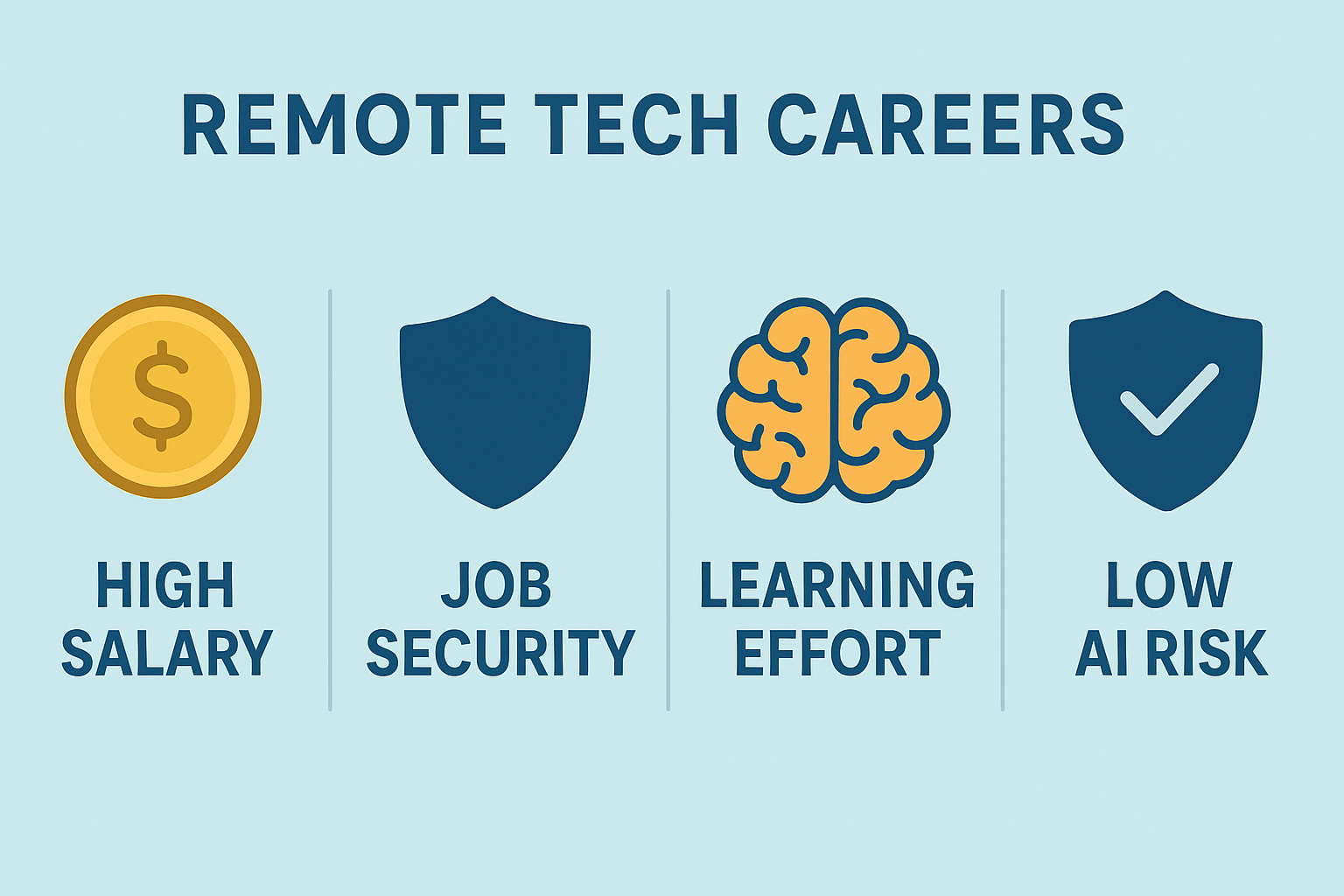
1. Technical Remote Roles (Software, Data, DevOps)
This includes:
software developers
data analysts and data scientists
AI and machine learning roles
DevOps and cloud engineers
Why these roles pay well
Global demand across industries
Clear skill validation
Mature hiring pipelines
Companies depend on these roles to function
Trade-offs
Requires focused learning upfront
Not instant gratification
Skills must be maintained over time
Why many people choose this path
High income ceilings
Strong geographic portability
Works extremely well with geoarbitrage
Clear long-term career resilience
This is the most stable and scalable remote income path for people willing to invest in skills. If the quiz points you here, the Remote Coding Membership is a practical starting point for beginners.

2. Tech-Adjacent Remote Roles (QA, PM, Support, Operations)
This includes:
quality assurance (QA)
project or product management
customer success
technical support
operations roles
Why these roles pay well
They support technical teams
They require both domain knowledge and communication
Many companies hire these roles remotely by default
Trade-offs
Lower income ceiling than core technical roles
More dependent on company structure
Often more vulnerable during layoffs
Who this path fits
People with strong organizational or communication skills
Career-switchers with relevant prior experience
Those who want remote work without deep technical retraining

3. Freelancing & Contract-Based Remote Work
This includes:
freelance developers
designers
consultants
contractors on platforms like Upwork or Toptal
Why this can pay well
You control your rates
You can work with multiple clients
Strong performers can out-earn salaried roles
Trade-offs
Income variability
Ongoing client acquisition
No built-in stability or benefits
Who this path fits
Self-starters
People comfortable with uncertainty
Those who value flexibility over predictability
Many people combine freelancing with another path for stability.

4. Content-Based Remote Businesses (YouTube, Blogging, Writing)
This includes:
YouTube channels
blogs and newsletters
digital products
affiliate-driven content
Why this can pay well
Potential for leverage
Income not tied directly to hours worked
Creative control
Trade-offs
Highly inconsistent income early
Long ramp-up time
Platform dependency
No guarantees
Important reality check
Most people underestimate:
how long this takes,
how many attempts fail,
and how much work happens before income appears.
This path works best as:
a long-term play, or
a secondary income stream alongside a stable remote job - not a starting point.

5. Hybrid Remote Paths (Stable Job + Side Income)
Many people don’t choose just one path.
Common combinations include:
a remote job plus freelancing
a coding role plus a content business (this is us!)
or part-time remote work plus a geoarbitrage strategy
This approach:
lowers risk,
smooths income,
and creates flexibility without burnout.

Hot air balloons launch at sunrise in Cappadocia, Türkiye
Why Choosing a Remote Career Feels So Hard
Most people don’t struggle because they’re incapable.
They struggle because they:
choose based on hype instead of fit,
underestimate the learning curve,
overestimate “easy money” paths,
or never see the full landscape before committing.
That’s what this page is here to fix - to slow the decision down just enough to make it a smarter one.
Still Not Sure? The Quiz Will Help
If you’ve read through the options and still feel unsure, that’s normal.
Different people thrive in different environments. Some need structure. Some need flexibility. Some want stability now and optionality later.
Check out the quiz at the top of this page to help guide you.
Some paths work best as long-term careers. Others are better as a starting point or a supplement. The quiz accounts for those differences so you’re not comparing apples to oranges.

Why We Often Recommend Remote Coding (When It Fits)
Across all remote income paths, coding stands out because it:
offers high income with fewer geographic limits,
scales well across companies and countries,
integrates cleanly with geoarbitrage strategies,
and provides long-term career resilience.
That doesn’t mean it’s right for everyone -
but it is the most consistently reliable remote income path for people willing to learn.
If you want a deeper, realistic look at coding as a remote career - including learning paths, comparisons, and expectations - that’s covered next.

Where to Go Next
Depending on where you are right now:
Learn Remote Skills - compare learning paths without pressure
Get Hired Remotely - understand how people actually get hired remotely
Remote Coding Membership - a deeper look at the most scalable remote income option
If you already know you want a structured, self-paced path that brings learning, projects, and job readiness together:










Many countries allow legal residency using retirement income, SSDI, VA benefits, or 401(k) withdrawals. Updated pathways and student visa options for 2026.