
Our Budgets, 2018 to 2023
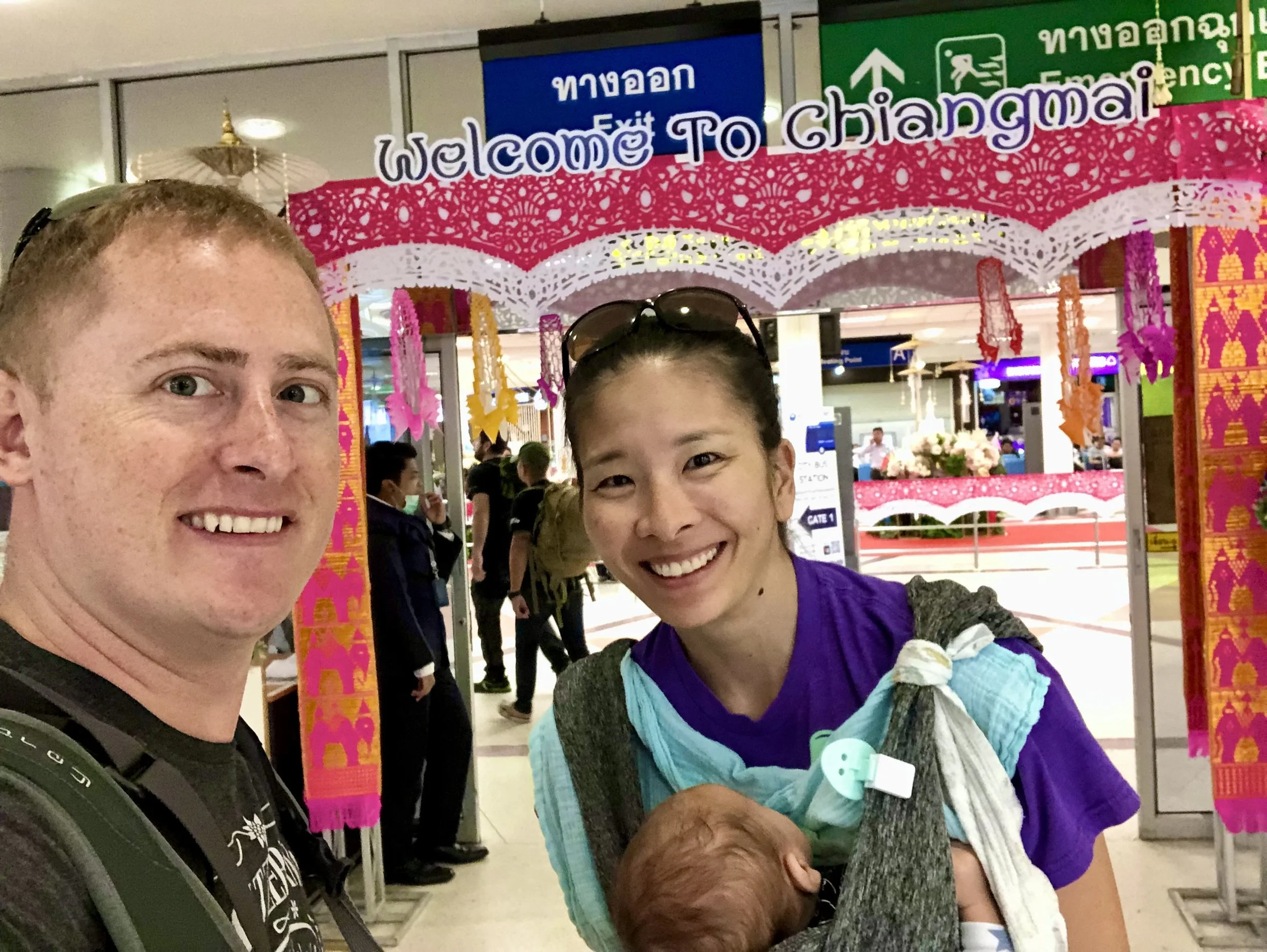
Chiang Mai, April 2019. March 2018 to February 2023: $144,621 for the two of us, every dollar logged.
Five years of travel budgets: the short answer
Our five years of full-time travel, from March 2018 to February 2023, cost the two of us $144,621. The first year was the most expensive by far, at $123 a day. The cheapest was a year we didn't choose: locked down in Malaysia, at $55 a day.
| Travel year | Where we were | Days | Spent, two adults | Per day |
|---|---|---|---|---|
| 1 (Mar 2018 – Feb 2019) | France, the Canary Islands, Morocco, Italy, Austria, the UK, Ireland, Belgium, Germany, Greece, Egypt, South Africa | 339 | $41,753 | $123 |
| 2 (Mar 2019 – Feb 2020) | Thailand, Malaysia, Bali, Fiji, Australia, New Zealand | 366 | $25,261 | $69 |
| 3 (Mar 2020 – Feb 2021) | Malaysia, through the pandemic lockdowns | 365 | $20,191 | $55 |
| 4 (Mar 2021 – Feb 2022) | Malaysia, Türkiye, Albania, Germany, a US family visit, Colombia | 365 | $30,096 | $82 |
| 5 (Mar 2022 – Feb 2023) | Colombia, Costa Rica, Mexico, US family visits, then New Zealand | 348 | $27,320 | $79 |
All figures are for two adults, in US dollars, from the spreadsheet where we logged every expense. Every price includes the sales tax, VAT or tourist tax we paid at the time. What's not included: health and travel insurance, income taxes and our business costs. A few small visa fees, like Egypt's visa on arrival and Türkiye's e-visa, are counted in transportation. Our two children were born during these years, but their costs came from a separate account and aren't included.
If you've seen yearly totals on our site before, these are slightly different: they're the final numbers, after refunds and corrections that came in after we first wrote those posts.
Year by year

Year one: 12 countries in 339 days, at $123 a day. La Palma, 2018.
Year one: Europe, Egypt and Cape Town, $41,753 ($123 a day)
We left Orlando in March 2018 with about a year of savings and a plan to see as much as we could. We did: twelve countries in eleven months, from Paris and the Canary Islands through Morocco, Italy, Austria, the UK and Ireland, to Belgium, Germany, Greece, Egypt and finally Cape Town.
It was the most expensive year by a wide margin, and almost all of the extra came from moving. Accommodation was $15,743 and transportation $11,458, more than in any later year. We set a nightly accommodation cap of $48.67 and mostly hit it: our riad in Marrakesh came to $48.45 a night, our apartment near Pompeii $48.52, our studio in Rome $48.62. But short stays, taxis and the tours we booked because we'd only be somewhere a week kept pushing us over. In our first two weeks in Italy alone, we ran about $1,000 over plan.
Most of our beds that year were whole apartments, but about one stay in three was a private room in someone else's home: near Paris, outside Pompeii, and in Venice, Edinburgh, London and Dublin. Rooms are the cheapest beds you can book, and even they didn't make Western Europe cheap. We also ate out more than in any later year: $6,641 in restaurants and cafés against $2,404 in groceries. And we rented cars for road trips in the Canary Islands, Britain, Ireland and South Africa, which added about $4,200 in rentals and fuel on top of $4,734 in flights.
What it taught us: fast travel is expensive travel. By the end of the year we were tired and over budget, and our first child was born in Cape Town in early 2019, just before the year closed.

Doi Inthanon, near Chiang Mai, April 2019. Year two: slower travel through Southeast Asia and the Pacific, at $69 a day.
Year two: Southeast Asia and the Pacific, $25,261 ($69 a day)
With a newborn, we couldn't move every two weeks, and we stopped wanting to. We cut the budget for year two by 43 percent and started staying one to three months in each place: Thailand, Malaysia, Bali, Fiji, Australia and New Zealand.
Malaysia changed how we planned. It was so cheap that we were living well under even the smaller budget, so the money we weren't spending there could pay for Australia and New Zealand. That became our rule for years: an expensive country is fine, as long as you surround it with cheap ones. We booked Bali to Fiji to Sydney to Auckland on one multi-city ticket, which made the expensive last leg affordable.
Where we slept changed too. With a baby, we stopped renting rooms in other people's homes and booked whole apartments and houses for a month or two at a time. Sharing would probably have been cheaper, but a family with a newborn needs its own space. Fiji shows how much the choice of place matters: we rented a house in Votualevu, a residential area near Nadi, for two months, at about $17 a night. A resort hotel would have cost far more.
We cooked more, too. Groceries rose to $3,072 for the year, and eating out fell to $4,394.
What it taught us: slowing down cut our daily cost almost in half, and it never felt like giving anything up.

Year three: canceling flights with a newborn in Malaysia. Keep a buffer for the plans that break.
Year three: a year in Malaysia, $20,191 ($55 a day)
We flew from New Zealand to Malaysia in February 2020, planning to move on to Taiwan in May. Then the world shut down. Malaysia's Movement Control Order began in March, every flight we had booked was canceled, and we stayed in Malaysia for the whole year. Our daughter was born there during the pandemic.
It was our cheapest year, and not by choice. Transportation fell to $2,552 for the whole year, and activities to $522. A lockdown is the slowest travel there is.
Lockdown changed how we ate as well. With restaurants closed for long stretches, we spent more on groceries ($3,961) than on eating out ($3,812) for the first time, and groceries stayed ahead from then on.
What it taught us: keep a buffer for the plans that break. And when the borders closed and our visas were days from running out, we learned to watch official announcements closely and never assume an overstay would be forgiven. Malaysia extended visitors' visas automatically.
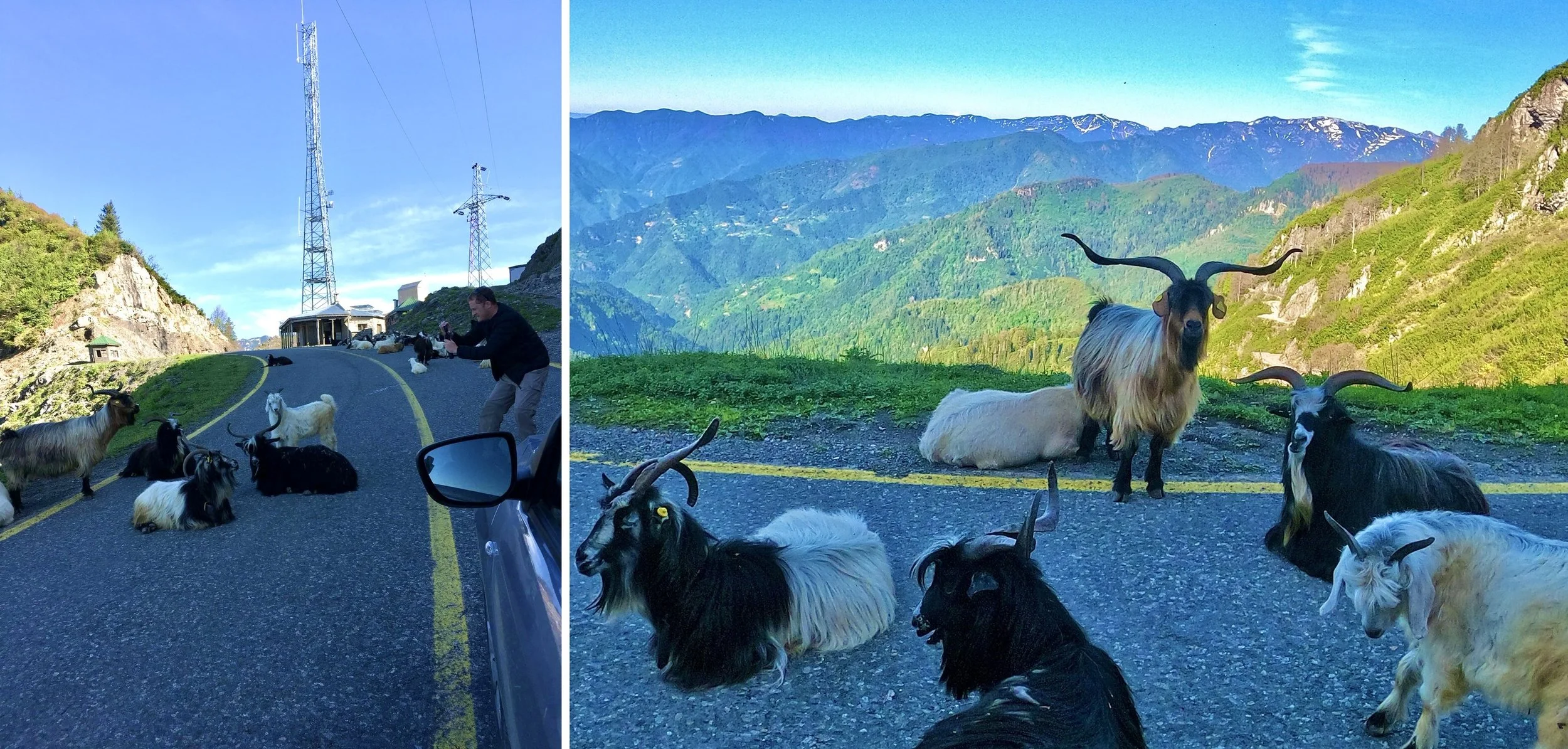
Year four: back on the move, through Türkiye, Albania and Colombia, at $82 a day. In Artvin, in May 2021, a herd of goats blocked the mountain road. I got out to take this photo and then shooed them along so we could pass, while Jenny wondered why I'd walk up to a herd of wild goats.
Year four: back on the road, $30,096 ($82 a day)
When travel opened up again, we left Malaysia for Türkiye, then spent almost four months in Albania, Christmas in Germany, a visit with family in the US, and the start of a stay in Colombia.
Costs went back up, and the reason is clear in the numbers: transportation tripled from year three, to $8,011, as we crossed continents again. Albania, at $68 a day, kept the year from getting expensive.
Most of that was flights, $4,701, plus $2,354 in rental cars and fuel. Food held steady because we kept cooking: $5,142 in groceries against $3,730 eating out.
What it taught us: long-haul repositioning flights are where a slow-travel budget gets hit. Plan them, price them early, and stay long enough at each end to spread the cost.
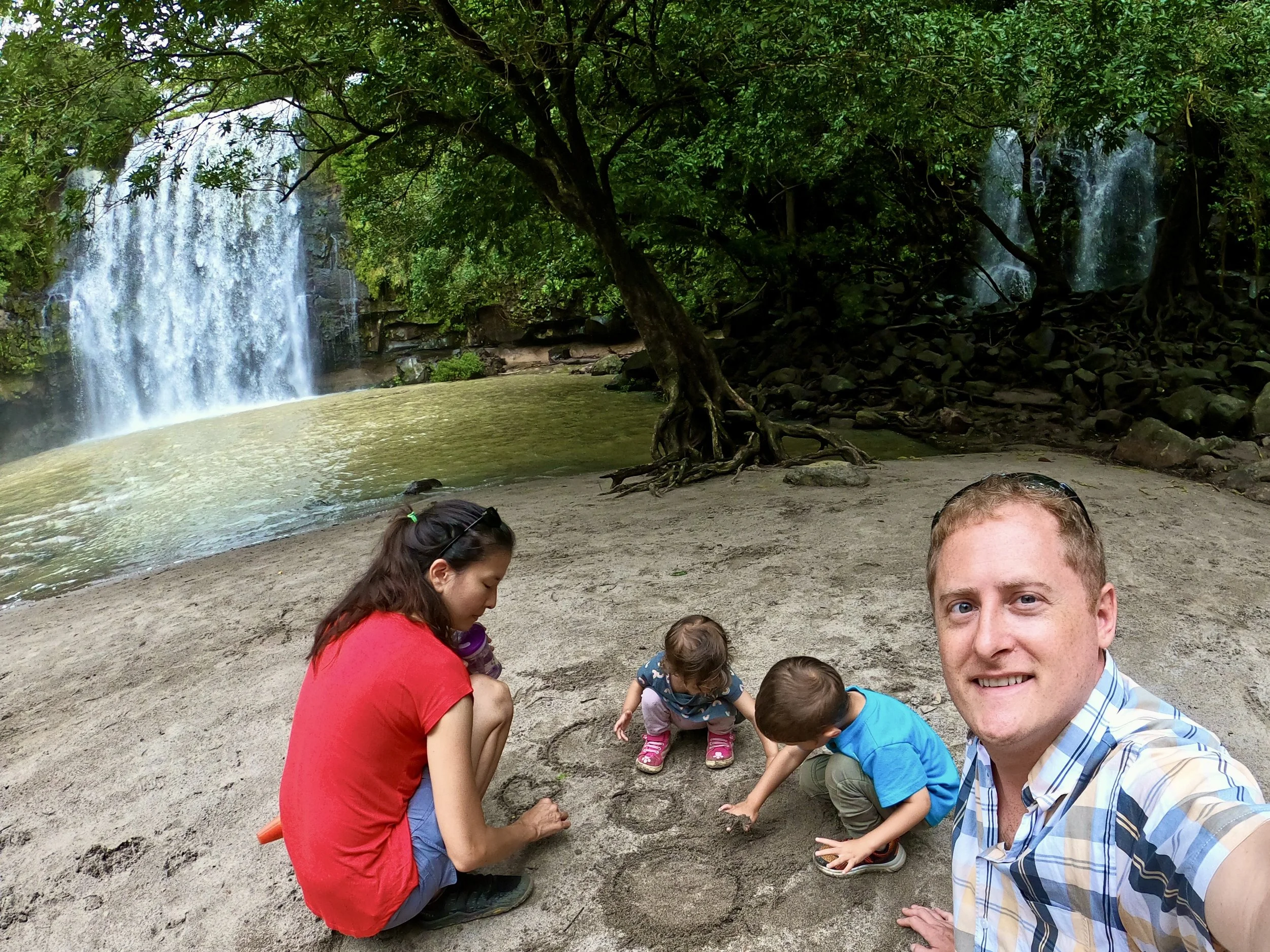
Llanos de Cortés, Costa Rica, June 2022. Year five: Colombia, Costa Rica and Mexico, then New Zealand, at $79 a day.
Year five: Latin America and the move, $27,320 ($79 a day)
Our last year of full-time travel was Colombia, Costa Rica and almost five months in Mexico, the cheapest country we ever lived in at $50 a day, with more family time in the US. In February 2023 we flew to New Zealand to settle.
Food split almost evenly that year, with $4,560 on groceries and $4,494 eating out. Taxis and rideshares reached $1,329, the most of any year.
What it taught us: we could keep living well for around $2,400 a month for two, even with two small children along and long flights home to see family.
What changed across five years
| Two adults, per travel year | Year 1 | Year 2 | Year 3 | Year 4 | Year 5 |
|---|---|---|---|---|---|
| Accommodation | $15,743 | $7,983 | $8,028 | $10,079 | $9,063 |
| Transportation | $11,458 | $6,535 | $2,552 | $8,011 | $5,522 |
| Food | $9,045 | $7,466 | $7,773 | $8,872 | $9,053 |
| Activities and tours | $4,221 | $1,787 | $522 | $898 | $1,471 |
| Everything else | $1,286 | $1,489 | $1,316 | $2,236 | $2,210 |
| Total | $41,753 | $25,261 | $20,191 | $30,096 | $27,320 |
Four patterns stand out:
Food is the steady line. It stayed between about $7,500 and $9,000 a year, whatever country we were in. What changed was the mix. We always cooked at home a lot, but in year one we also ate out constantly, and almost three-quarters of our food money went to restaurants and cafés. From year three on, groceries took the bigger share.
Accommodation and transportation are the levers. Together they fell from $27,201 in year one to $10,580 in year three. Those two lines are almost the whole difference between our most and least expensive years, and both are driven by how often you move.
Sharing a home is the cheapest bed. A private room in someone's home costs less than a whole apartment, and we used them a lot in year one. With small children we moved to whole places, which cost more. If you're traveling as a couple, renting rooms is one of the easiest ways to cut the biggest line in your budget.
Activities collapsed once we slowed down. From $4,221 in year one to between about $500 and $1,800 a year after that. When you live somewhere for two months, you don't need a paid tour to see it.
How the food money split, cooking against eating out:
| Two adults, per travel year | Groceries (incl. convenience stores) | Restaurants, cafés and takeout |
|---|---|---|
| Year 1 | $2,404 | $6,641 |
| Year 2 | $3,072 | $4,394 |
| Year 3 | $3,961 | $3,812 |
| Year 4 | $5,142 | $3,730 |
| Year 5 | $4,560 | $4,494 |
The "everything else" line grew over time, mostly small things a family accumulates: clothes, toiletries, phone plans and household items. That's the one line where slow travel doesn't help much.
Frequently asked questions
How much did it cost to travel the world for five years?
$144,621 for the two of us, from March 2018 to February 2023. That's about $29,000 a year, or $81 a day. Sales tax and VAT are included, because they were part of what we paid. Insurance and income taxes are not.
Why was the first year so expensive?
Speed. We changed countries every few weeks, which meant more flights, more taxis, short-stay rental prices and more paid tours. Once we started staying one to three months in each place, our daily cost fell from $123 to between $55 and $82.
Did having children make travel more expensive?
Their costs came from a separate account set aside only for children, so they're not in these numbers. What children did change was our pace: a baby slowed us down, and slowing down was the biggest saving we ever made.
What would you do differently?
Start slow from day one, and cook more from the start. Our year one would have cost thousands less if we'd stayed a month or more everywhere and eaten out less.
Did you cook at home or eat out?
Both, in every country. We cooked a lot, but we ate out too, especially in year one, when restaurants and cafés took almost three-quarters of our food money. By year three, we were spending more on groceries than on eating out, and that held for the rest of the trip.
Is renting a room in someone's home cheaper?
Usually, yes. About one in three of our stays in year one were private rooms in other people's homes. But a room doesn't make an expensive region cheap: year one was still our most expensive year. Once we had a baby, we booked whole places, which cost more.
Keep going
Country by country: What it costs to live abroad, with monthly costs, rent and food for 18 countries.
The method behind the numbers: our book Travel That Lasts: The Slow-Travel FIRE Playbook, with seven worksheets to build your own plan. See the book.
Find the income: the free Find Your Remote Path quiz.
The proof it adds up: How we saved over $120,000 traveling the world.
The whole story: our memoir, Two Weeks a Year. About the book.
These are our own numbers from 2018 to 2023, shared as our experience and general information, not financial advice.