
Learning the Language and Culture

Matamata, April 2023. You'll see and hear te reo Māori every day in New Zealand.
You can live somewhere for years on English alone. But some doors stay closed until you speak a little of the local language and know how things are done. Language comes first. Culture comes with it.
The class where Bradley didn't understand the words
In March 2026, a barber in our village invited Bradley to a mau rākau class, the Māori art of weaponry, held across from a marae in Lower Hutt. He went, and felt very welcome. But the class spoke mostly English with words in te reo Māori that he didn't understand.
As a Marine veteran, Bradley found the training part familiar. The language part didn't. Bradley decided the language had to come first, so he'd understand what people were telling him to do. He plans to go back once he's learned more of it.
That's the whole case for this guide. You can show up to a place, and people can welcome you. But to really take part, you need at least some of their words.
The question I couldn't answer
During my first job in New Zealand, my employer offered staff an introductory course in te reo Māori, for free. I signed up. Early on, the course asked each of us a question, the way these courses do: what is your whakapapa?
Whakapapa is genealogy, but it's more than a family tree. It's how a person is connected to their ancestors, to the land, and to the people around them. For Māori, it says who you are and where you stand.
When I was asked it, I went blank. I didn't know what the word really meant to Māori, and I didn't know what it meant to me. I'm what Americans call a mutt: a mix of countries, mostly from Europe, too many to name with any confidence. My roots in the United States weren't deep either. I'd pulled them up, lived all over the country, and then spent years traveling the world. So when someone asked where I come from, in the way that question is meant here, I didn't have an answer. I had to stop and really think about it, and try to see it the way Māori see it.
Where I've got to since. Whakapapa isn't a list of percentages. It's about relationships: who you come from, what holds you to a place, and who comes after you. Seen that way, my answer isn't blank at all.
I come from people who uprooted themselves. Somewhere back there, my ancestors left Europe and crossed an ocean to start again. My parents were working people: my mother drove a school bus, and my father, Michael Paul Urias, was a construction painter. I did what those ancestors did. I pulled up my roots and crossed an ocean, with Jenny and our two kids, who were born on the road.
I stand here by a relationship, not by birth. I'm not Māori, and I don't claim a mountain or a river here as mine. I'm here as one of tangata Tiriti, the people who belong in Aotearoa through Te Tiriti o Waitangi, the Treaty that made room for newcomers alongside tangata whenua, the people of the land. That relationship comes with obligations. Learning the language is one of them.
It runs forward too. For our daughter, New Zealand was the only home she knew. Our son's whakapapa pages at school already include his Papa Mike. Whatever I work out about my own lines, my children's whakapapa will include Aotearoa.
I still don't have a polished answer, and that's fine. Learning te reo is partly about earning the right to give one.
Why it's worth the effort
Respect. Trying to speak someone's language, even badly, tells them you take their place seriously.
Access. Prices, friendships, invitations and local knowledge all open up when you can say more than "hello".
Safety. You understand signs, warnings, doctors and officials, at least in part.
Your own life. Kids pick it up fast. Adults who don't learn can end up on the outside of their own family's new life.
You don't need to be fluent. You need to start, and to keep going.

Quepos, Costa Rica, June 2022. Food words and numbers first. They get used every day. And in Costa Rica, "pura vida" covers most of the rest.
How to start
Most adults don't learn a language the way they did in school. They learn it the way they learned a new job: the words they need first, then more as they go.
Your first 50 words
Start with what you'll use every day, not with grammar tables:
Greetings and goodbyes, for morning, evening and leaving.
Please, thank you, sorry and excuse me. These four do more for you than any others.
Numbers, for prices, addresses and times.
Food words, for the market, the menu and allergies.
Directions and places: left, right, here, there, toilet, pharmacy, hospital.
"I don't understand" and "Please speak slowly". They keep a conversation going instead of ending it.
Use them from day one, badly. People almost always appreciate the effort.
Get the sounds right
Pronunciation matters more than vocabulary at first. A few words said well get you further than many said wrong, and mispronounced place names stand out. Listen to native speakers, repeat out loud, and ask people to correct you.
Habits that stick
Ten minutes a day beats an hour a week. An app, flashcards, a podcast on a walk.
Learn from your real life. Label things at home. Read the menu at your regular café. Learn the words on the signs you pass.
Take a class, if one fits. A teacher and classmates keep you going when motivation runs out.
Find a language exchange. Trade an hour of English for an hour of theirs.
Make mistakes in public. It's the fastest way to learn, and locals usually help.
From someone who taught it
Jenny taught English in Japan for six and a half years, so she's seen what works from the other side of the desk.
In her words: "Learners who made real progress practiced every day. They weren't afraid to make mistakes. They communicated with what vocabulary they knew."
On the road
While slow-traveling, we couldn't learn every language. We moved too often. What we could do was learn the basics everywhere we went: greetings, thank you, numbers and food.
Timing turned out to matter as much as the app. Jenny studied Italian on Duolingo long before we reached Italy. With no way to practice it, she'd forgotten a lot of it by the time we arrived.
German went differently. We both studied it on Duolingo, practiced with each other, and got to Germany while we were still learning. We used our phrases at the Christmas markets and in the supermarkets, and even our daughter said "bitte" to the clerks on the way out of the store.
School languages can come back, too. Bradley took Spanish in high school and college. It was rusty by the time we reached Spanish-speaking countries, but he picked it up again quickly, and Google Translate filled the gaps. His two semesters of college French didn't last until France.
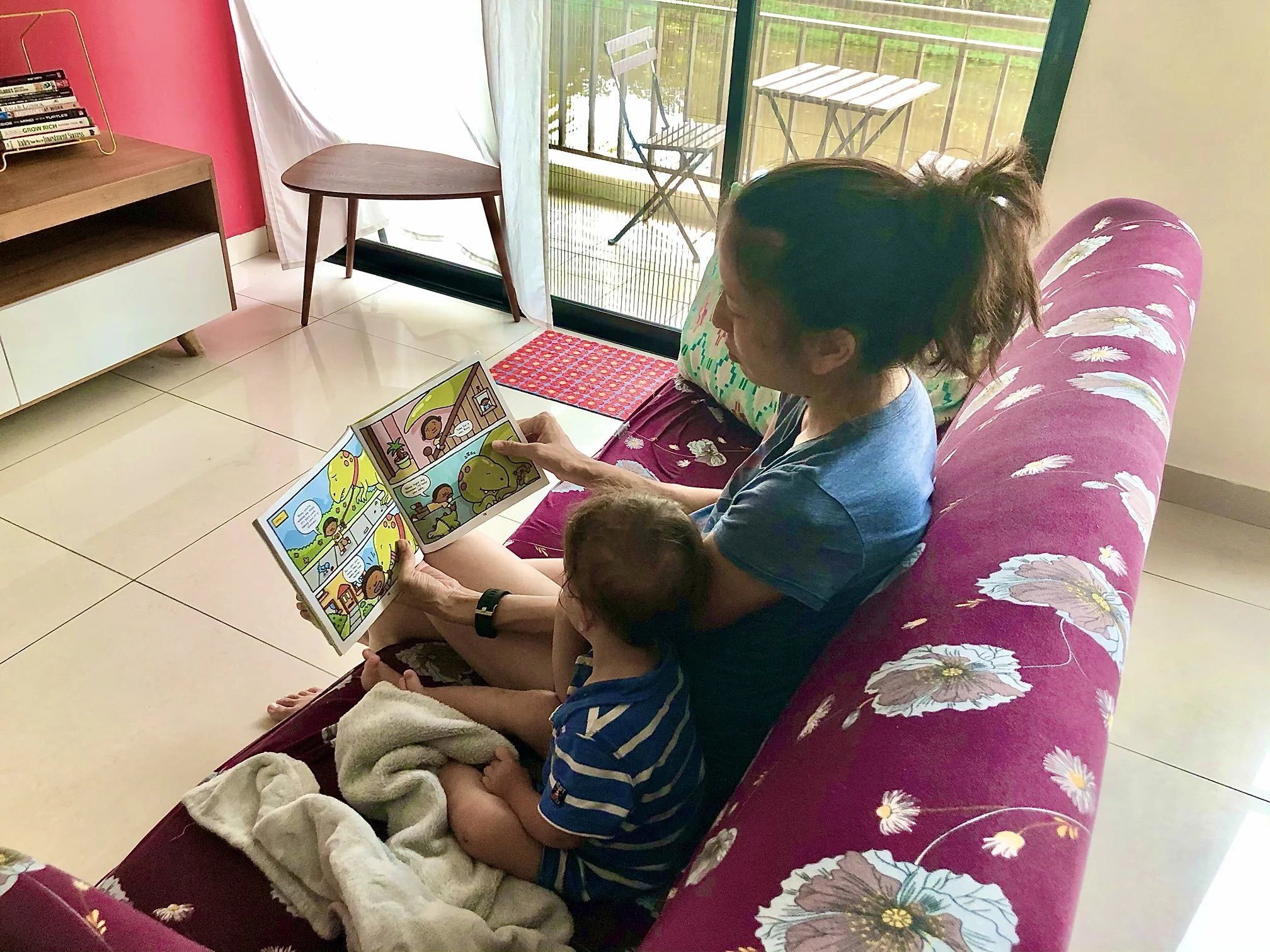
Gelang Patah, Malaysia, September 2020. Let the kids lead. They learn faster, and they're less embarrassed.
Learning as a family
Kids learn languages faster than adults, and they're less embarrassed about mistakes. Let them lead, and learn alongside them.
In New Zealand, we're learning te reo Māori together, slowly. We teach our kids some of the language, take them to museums like Te Papa, New Zealand's national museum in Wellington, and read books together, to make it familiar to them and to us. In Bradley's words: "So we are trying, but we're not moving at a rapid rate. We are learning as we go."
Much of what Bradley knows came through the kids. They learned te reo at school, and now that we homeschool, he learns it from the schoolbook material so he can teach it to them.
What helps a family learn together:
Make it part of the day. A greeting at breakfast, names for food at dinner, a word of the week on the fridge.
Read together. Children's books in two languages are a gentle way in for everyone.
Go where the language lives. Museums, festivals, cultural events and community days.
Let the kids teach you. If they're learning at school, ask them what they learned today, and use it.
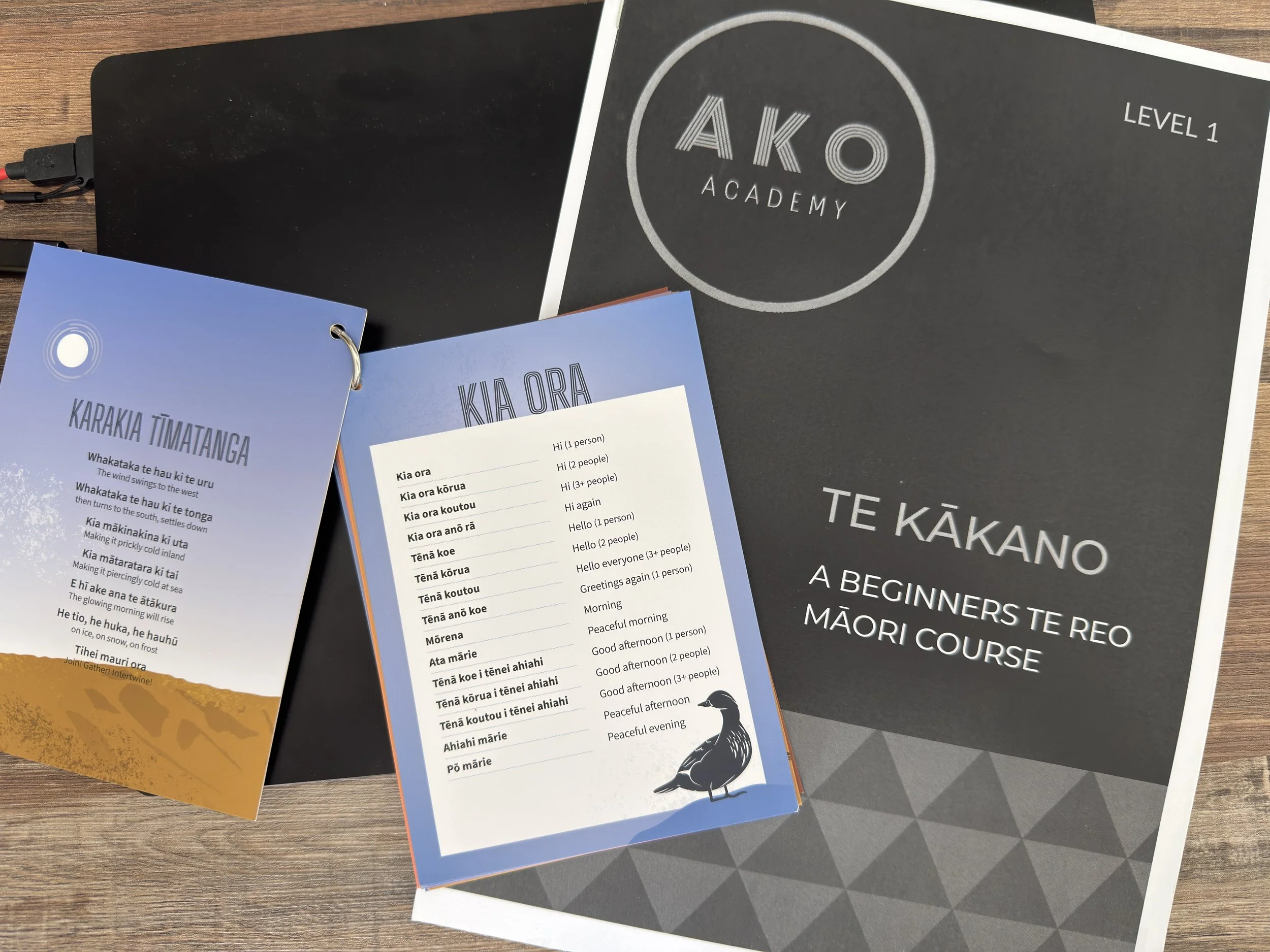
September 2023. Bradley's first te reo course, AKO Academy's Te Kākano, was free through his employer.
Learning te reo Māori in New Zealand
Te reo Māori is one of New Zealand's official languages, and you'll hear it every day. Learning some of it is one of the most respectful things a newcomer can do. Here's where we'd point a fellow newcomer.
Start with what you'll hear every day
Greetings. Mōrena means good morning. You'll hear "kia ora" everywhere, as hello and thanks.
Place names. Many are Māori. Learn to say the ones around you properly. It's the most visible sign that you're trying.
Everyday words that turn up in New Zealand English, like kai (food) and whenua (land), and words like marae, the meeting grounds of a Māori community, and iwi, a tribe or people.
Vowels. Māori vowels are short or long, and a macron (the line over a vowel, as in Māori) marks a long one. It changes the meaning, so it's worth getting right.
Free and low-cost ways to learn
Te Wānanga o Aotearoa runs Papa Reo Level 1 online, which lists "No fees" when we checked in November 2026. It's for people 16 and over who live in New Zealand and are citizens or residents (or Australian citizens or permanent residents). It's a year-long, part-time course, averaging about 12 hours a week.
Te Aka Māori Dictionary has meanings, examples and audio for pronunciation.
Ask your employer. Many New Zealand workplaces offer free te reo courses to staff. That's how Bradley took his first introductory course, and Jenny took a class of about 10 weeks through hers.
Local classes. Community centers, libraries, schools and marae often run evening classes. Ask locally.
Te Wiki o te Reo Māori, Māori Language Week, each September, brings events and resources across the country.
For pronunciation, Bradley used an app called Say It Right, which let you hear how each word should sound. As far as we know, it isn't available anymore.
Wherever you live
The same idea works anywhere. Many countries have a first people whose language is still spoken: in place names, in ceremony, in daily life. Learning some of it, alongside the national language, tells people you see the whole place, not just the parts that are easy for visitors.

Auckland Airport, February 2023. Watch first. Ask well. Take part when you're invited.
Culture beyond words
Language gets you into the room. Culture is knowing how to behave once you're there. Most of it isn't written down, so you learn it by watching, asking and getting some of it wrong.
Watch first
Before you act, notice how people:
greet each other. A handshake, a kiss, a bow, a hongi. In New Zealand, the hongi, pressing noses and sharing breath, is a Māori greeting you may be welcomed with at a marae or a gathering. At Bradley's mau rākau class, everyone shared a hongi at the start and the end.
treat time. Some places run to the minute. Others start when everyone's there.
speak about themselves. In New Zealand, modesty matters, and loud self-promotion that's normal in the US can land badly.
behave in sacred or formal places. Shoes off, heads covered, voices low, no photos. When in doubt, ask.
share food. Who eats first, whether to bring something, how to say no politely.
Ask well
People are usually glad to explain their culture to someone who asks with real interest. A few ways to do it well:
Ask privately, not in front of a crowd.
Ask about meaning, not just rules: "Why is that done?" rather than only "What do I do?"
Don't expect one person to speak for everyone. Customs differ between families, regions and generations.
Read first. Museums, local histories and books written by people from that place answer the basics, so your questions can go deeper.
When you get it wrong
You will. We have, many times. Apologize simply, ask how it should be done, and do it right next time. A mistake made while trying is almost always forgiven. Not trying is what people remember.
Don't turn culture into a costume
Learning a culture isn't the same as taking it. Be careful with sacred symbols, designs, songs and ceremonies. Take part when you're invited, the way you're invited, and don't use them as decoration or as content for social media.
A short checklist
Learn greetings, thank you, sorry, numbers and food words in your first week
Learn to pronounce the place names around you
Spend ten minutes a day on the language
Take one class or join one language exchange
Visit a museum or read a local history written by people from there
Ask one person about a custom you don't understand
Learn alongside your kids, if you have them
Keep reading
Our New Zealand hub
Two Weeks a Year, our memoir, with a glossary of the Māori and Hawaiian words in it