
Giving Back Where You Live

Spending locally is the simplest way to give back.
People who move abroad for a better life take something from the place they move to: lower costs, safety, beauty, a welcome. That's not wrong. But it comes with a debt, and the best newcomers find ways to pay it back.
The real math of moving somewhere cheaper
We built our life abroad on geoarbitrage: earning in dollars and spending where life cost less. Over five years, the two of us averaged about $2,470 a month abroad, about half what the same life would have cost in Orlando.
That gap is the reason the strategy works. It's also a reminder. The savings come from somewhere: wages that are lower than ours, rents that locals can barely afford, and services built by people who'll never earn what we do. When newcomers arrive in numbers, rents rise and neighborhoods change, and the people who were there first often pay the price.
We can't fix that alone. But we can make sure our being there is good for the place, not just for us.
Giving back isn't charity
Giving back isn't about grand gestures or photos with children in orphanages. It's mostly ordinary things, done steadily:
spending your money where it stays local
giving your time and skills where they're needed
treating the land, the Animals and the people with care
supporting what locals are already doing, not starting your own thing on top of it
The rest of this guide covers how, and what we're building to do it ourselves.

Butterfly Creek, Eastbourne, January 2024. Volunteers built and look after these tracks. Join what's already there before starting your own thing.
Ways to give back that actually help
With your money
Spend locally and regularly. The local café, takeaway, market stall and hardware store. Small independent businesses run on regulars.
Pay fair prices. Don't haggle hard over small sums with people who earn far less than you.
Rent long term. Renting a home for a year or more, rather than a string of short stays, keeps housing in the market for the people who live there.
Give to local organizations, like food banks, community gardens, conservation groups and school fundraisers, not just big international charities.
Pay your taxes where you owe them. Roads, schools and hospitals you use are paid for by somebody.
With your time
Volunteer with what's already there. Food banks, beach and river cleanups, tree planting, sports clubs and school events always need hands. Ask what they need before offering what you'd like to do.
Use your workplace's volunteer days, if you have them. Many New Zealand employers offer at least one a year. Bradley's first job here did.
Show up for the community, at the school fair, the working bee or the fundraiser. Being there counts.
With your skills
Newcomers often bring skills a community is short of: coding, bookkeeping, teaching, trades, languages. Offer them where they're wanted, on the community's terms:
help a local nonprofit with its website or its accounts
mentor someone starting out in your field
teach a free workshop at the library or community center
With Nature
Wherever you live, you're a guest of the land as well as of the people.
Stay on the tracks, take your rubbish home, and leave Animals and Birds alone.
Join a planting day or a predator-trapping group. In New Zealand, many communities are working to protect native Birds that live nowhere else on Earth.
Fly less once you're settled. It's the biggest single change most of us can make to our footprint.
Kai means food. Kaimunity is food and community, together.
What we're doing: Kaimunity
Giving back is easy to write about. So here's what we're actually building to do it.
Where the idea came from
In Eastbourne, our village across the harbor from Wellington, the takeaways were part of everyday life: school nights, late finishes, rainy evenings. They were also where we stood waiting. Those waits got us thinking about how small local food businesses could serve their regulars better, without handing a big cut of every order to the large delivery apps.
That became Kaimunity: a pickup-first food app for local cafés and eateries in New Zealand. Kai is the Māori word for food. Kaimunity is food and community, together.
How it gives back
Kaimunity is being built around two ideas:
Keep more of each order with the local business. You order ahead and pick up, and the café or takeaway keeps more of what you spend.
Return about half of its revenue, after costs, to local community organizations. The money from food bought in a community goes back into that community.
We're also creating a cultural advisor role, so that Kaimunity is built with Māori input from the start rather than added on afterward. It's the same lesson as the rest of this series: learn first, and build with people, not just for them.
Where it stands
As we write this, the app is built and being tested, and the first restaurants are planned for early 2027, starting in the Waikato, where we live now.
If you run a café or eatery in New Zealand and you'd like to hear about it, email us at info@eatwanderexplore.com.
Why we're telling you
Not to sell you anything. Kaimunity is our own answer to the question at the top of this guide: what do you owe a place that welcomed you? Yours will look different, smaller or bigger. What matters is that you ask the question.
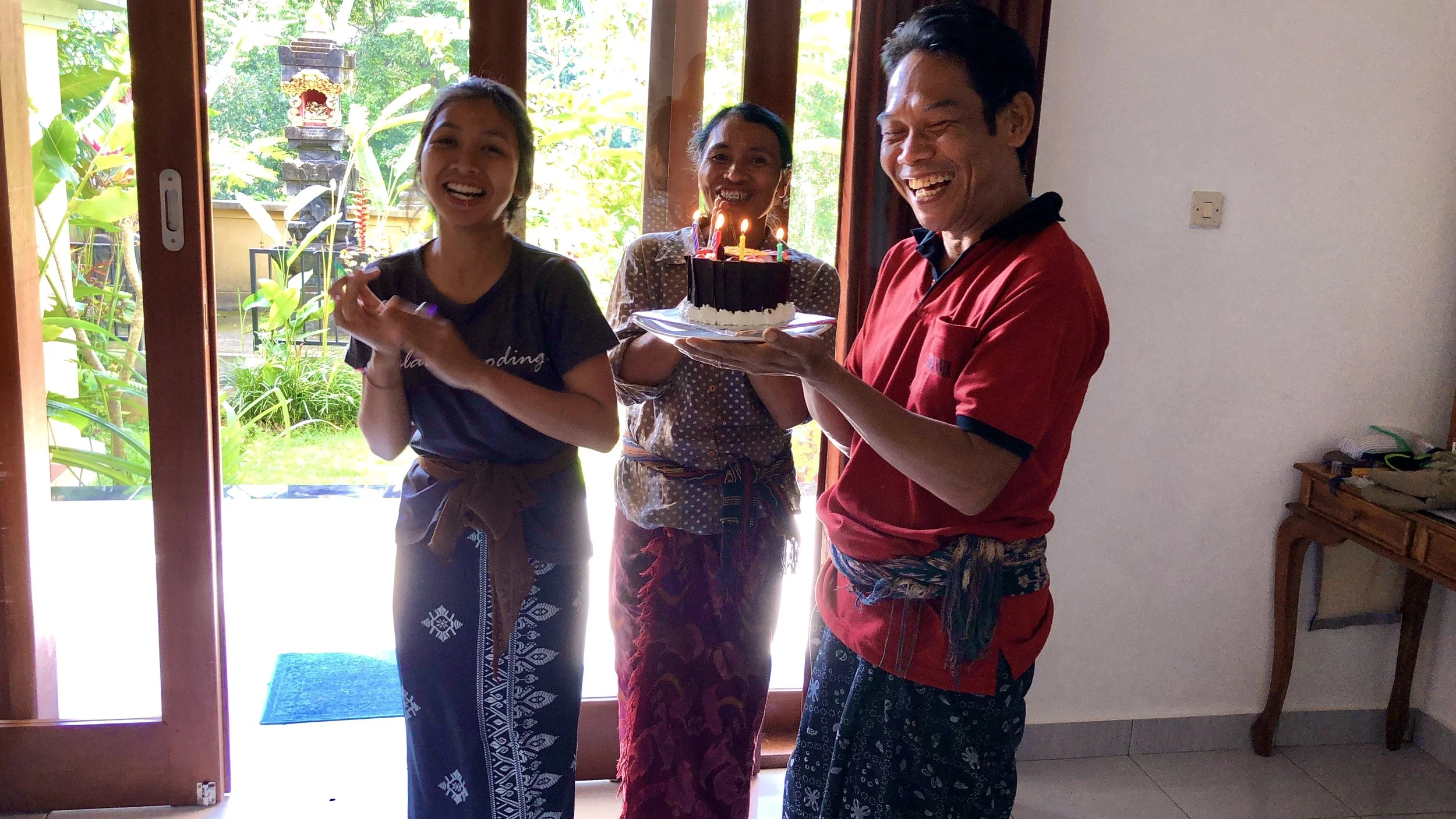
Tegallalang, Bali, July 2019. Our guesthouse sat in our hosts' family compound. The owner regularly drove us into town, and they made a cake for Bradley's birthday. Stay longer, move less, and spend with locally owned places.
Giving back when you're only passing through
For five years we stayed one to three months in each place. That's too short to join a club or start a project, but not too short to give back.
Stay longer, move less. Slow travel spends more of your money with local businesses and less on flights.
Choose locally owned places to stay, eat and book tours with.
Tip the way locals do, and a bit more where wages are low.
Leave a review for the small places that looked after you. For a family-run business, it matters more than you'd think.
Buy from makers, not souvenir shops selling imports.
The voluntourism trap
Short-term volunteering abroad can do more harm than good, however well meant. Be wary of:
orphanage visits or volunteering with children, which can disrupt kids' lives and, in some places, has fueled orphanages that exist to attract foreign money
building projects done by unskilled visitors that take paid work from local tradespeople
programs that charge you a lot to volunteer, where it's unclear how much reaches the community
anything where the photos seem to be the point
If you want to help while traveling, give money to a local organization with a good record, or offer a skill that's actually been asked for.
A short checklist
Spend most of your money with local, independent businesses
Rent long term if you're staying
Give regularly to one local organization
Volunteer with something that already exists
Offer one skill where it's wanted
Join one Nature project: a planting day, a cleanup, a trapping group
Ask what the community needs before deciding what to give
The end of the Belong series
This is the last of our four Belong guides. Becoming part of a place starts with arriving as a guest. You find your people, learn the language and the culture, and in time you give back to the place that took you in. None of it happens in a month, and none of it is ever finished.